

Project Survey
For the execution of projects involving the transport of oversized and overweight cargo—such as equipment for wind power projects—conducting a project survey is a mandatory requirement. This process enables the presentation of an optimal, safe, and highly cost-effective transport plan to the project owner.
In 2021, the company established a specialized survey department dedicated to projects involving the transport of wind power equipment and other oversized or overweight cargo. This department serves both the company’s own transport operations and external clients requiring such survey services.
The scope of a project survey includes:
a1. Onshore Project Survey
• Route Survey:
• Measure the width, curvature, and turning radius along the entire route from the seaport/receiving point to the project site.
• Assess the load-bearing capacity of road surfaces, bridges, culverts, underpasses, and overhead power lines (vertical clearance).
• Survey of Obstacles and Transport Infrastructure:
• Identify traffic signs, signal lights, trees, utility poles, or transformer stations that require temporary removal or relocation.
• Evaluate mooring and unloading facilities at the seaport to ensure sufficient draft and structural integrity for handling heavy/oversized cargo.
• Traffic Management and Coordination Survey:
• Coordinate with traffic police and road authorities to develop traffic diversion plans or schedule transport operations during nighttime hours.
• Transmission Line Survey (for lines crossing the transport route):
• Survey high/medium/low-voltage electricity transmission lines as well as local utility lines.
• Develop plans and solutions for raising power lines or constructing temporary bypass routes to avoid interference from overhead lines.
• Assess the condition, load-bearing capacity, lane dimensions, and bridge span lengths of bridges and culverts; survey temporary access roads and mountain pass routes.
a2. Survey for offshore wind power projects
In 2022, the Company signed a cooperation agreement with Hughes Subsea (United Kingdom) to provide offshore project survey services, as well as explosive ordnance disposal (EOD) and unexploded ordnance (UXO) clearance services for nearshore and offshore wind power projects within Vietnamese territorial waters.
Scope of work includes:
• Marine Geophysical & Geotechnical Surveys:
• High-resolution shallow seismic profiling, magnetic surveys, and side-scan sonar surveys to detect seabed obstructions, wartime unexploded ordnance, or existing subsea pipelines and cables.
• Geotechnical borehole drilling at locations designated for monopile, jacket, or floating foundations.
• Clearance of explosive ordnance and unexploded ordnance from the seabed using specialized Remotely Operated Vehicles (ROVs).
ESCORT
Introduction
Escort and transport security services are not merely technical measures; they are also mandatory legal requirements designed to ensure the safety of assets and transport infrastructure. For ultra-large equipment—such as wind power components featuring blades 70 meters or longer and weighing tens of tons—the role of the escort team is critical to the success of the entire project.
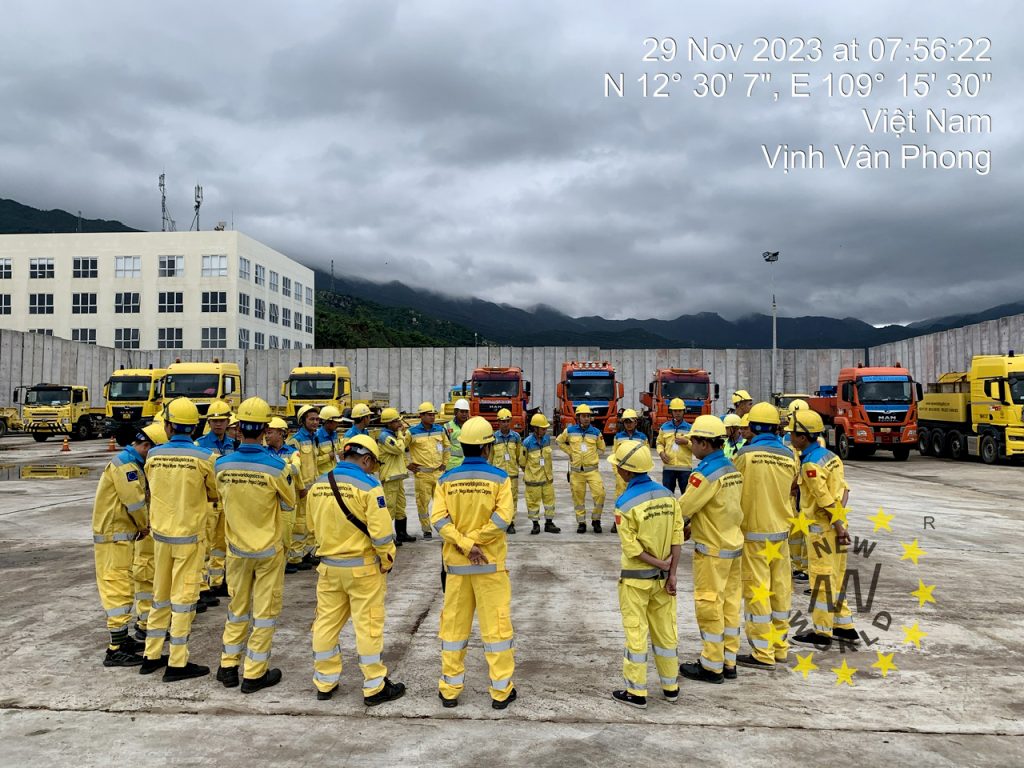
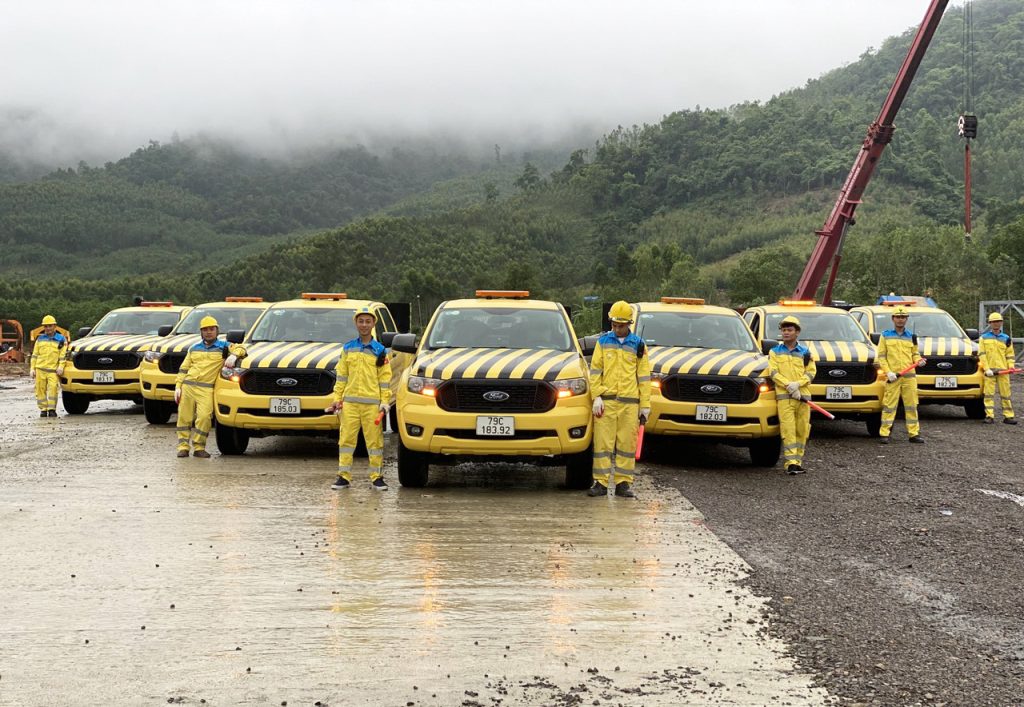
Since 2021, the company has provided escort and security services for the transport of wind power equipment, as well as other oversized and overweight cargo, across Vietnam and Laos.
In 2022, the company’s escort team received formal training and certification from the Traffic Police Department (under the Ministry of Public Security), making it the first and, to date, the only entity in the country to be granted such accreditation.
1. Ensuring public safety and traffic flow:
- Preventing other vehicles from entering the extensive “blind spots” of oversized transport vehicles (heavy-duty tractor-trailers).
- Providing early warnings to oncoming traffic on mountain passes or narrow curves, allowing them to proactively yield the right-of-way.
- Coordinating with traffic police to escort the convoy transporting wind turbine blades along the designated route.
2. Protecting high-value assets and national infrastructure:
- Wind power components (such as turbines and generators) are of immense value. The escort team identifies potential risks along the route—even a minor collision with tree branches, power lines, or road dividers could result in the total destruction of the cargo.
- The escort team ensures the vehicle remains centered on the roadway, preventing it from veering onto soft shoulders, collapsing drainage structures, or striking bridge railings, thereby safeguarding the road infrastructure.
3. Strict compliance with legal regulations:
This is a mandatory requirement under current law for a permit for the transport of super-heavy or oversized cargo to remain valid. Any violation will result in severe administrative penalties for both the business and the driver, as well as the revocation of the permit.
4. Responsibilities
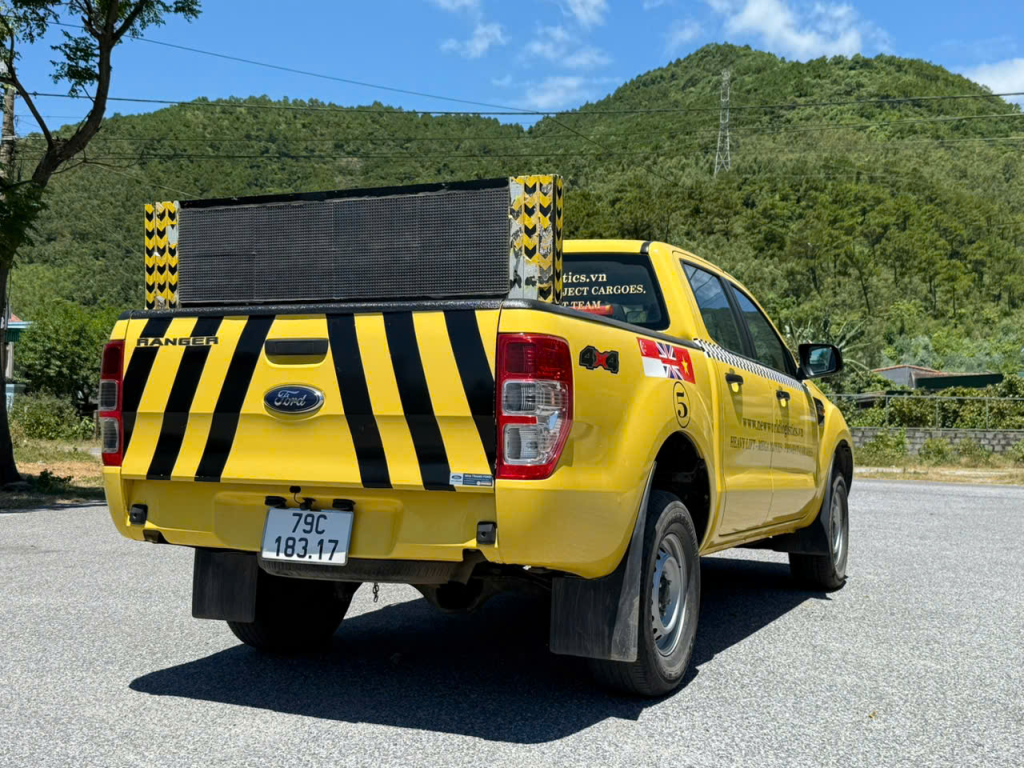
- Lead vehicle (at the front):
- Travels ahead of the convoy at a safe distance (typically ranging from several hundred meters to 1 km, depending on the terrain).
- Provides early warning to oncoming and same-direction traffic regarding the convoy’s exceptional dimensions.
- Coordinates the lifting or moving of telecommunication and power cables, and guides other road users to yield the right-of-way at bottlenecks, narrow bridges, or sharp bends.
• Tail-end (rear) escort vehicle:
- Follows closely behind the convoy or specialized trailer (such as an extendable trailer or a blade-lifting/rotating trailer) to alert following traffic and prevent unsafe overtaking.
- Monitors the rear section of the cargo—such as the tips of long wind turbine blades that may swing outward during turns—and provides continuous updates via two-way radio.
• Traffic regulation and coordination:
- Utilizes authorized warning lights and specialized sirens in compliance with legal regulations.
- Halts or directs other vehicles at sharp turns to ensure the oversized/overweight transport unit has sufficient “maneuvering space,” preventing it from mounting curbs or colliding with obstacles.
- Coordinates with local traffic police at complex intersections or along critical routes.
3. Incident handling, debriefing, and post-trip evaluation
• Emergency response: Immediately halt the convoy upon encountering road subsidence, landslides, overhead cables, or technical issues with the trailers; deploy warning signs at an appropriate distance.
• Reporting and handover: Maintain a trip log and coordinate the inspection of cargo condition upon arrival at the destination, prior to unloading the items at the project site.